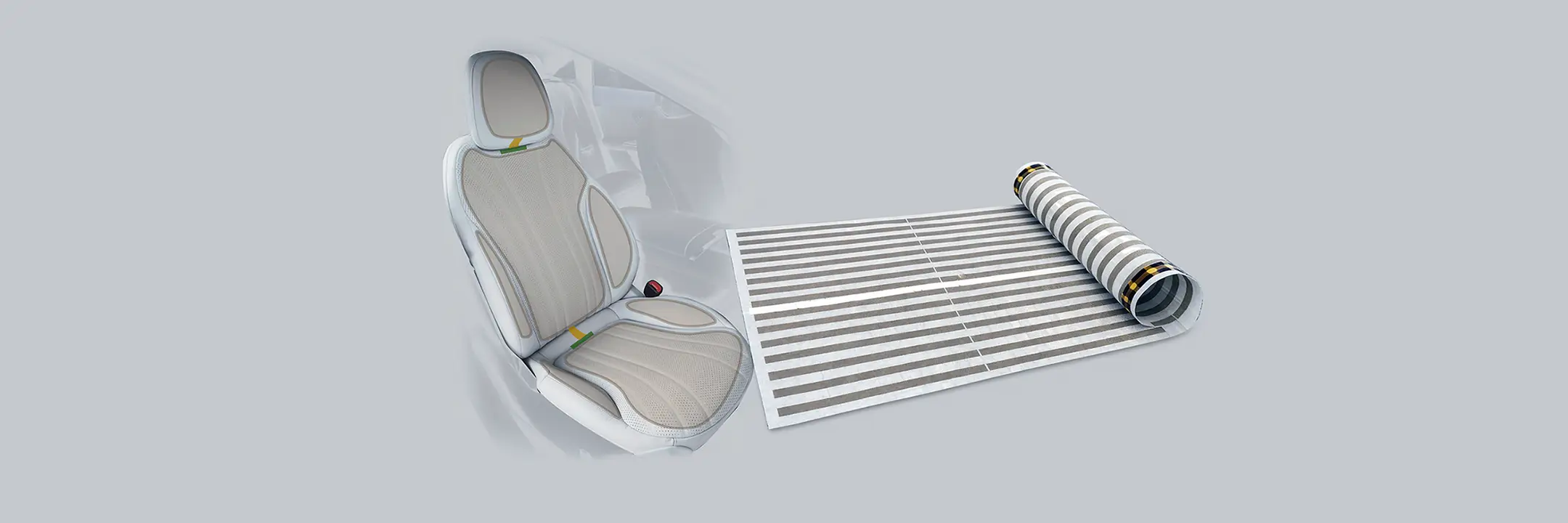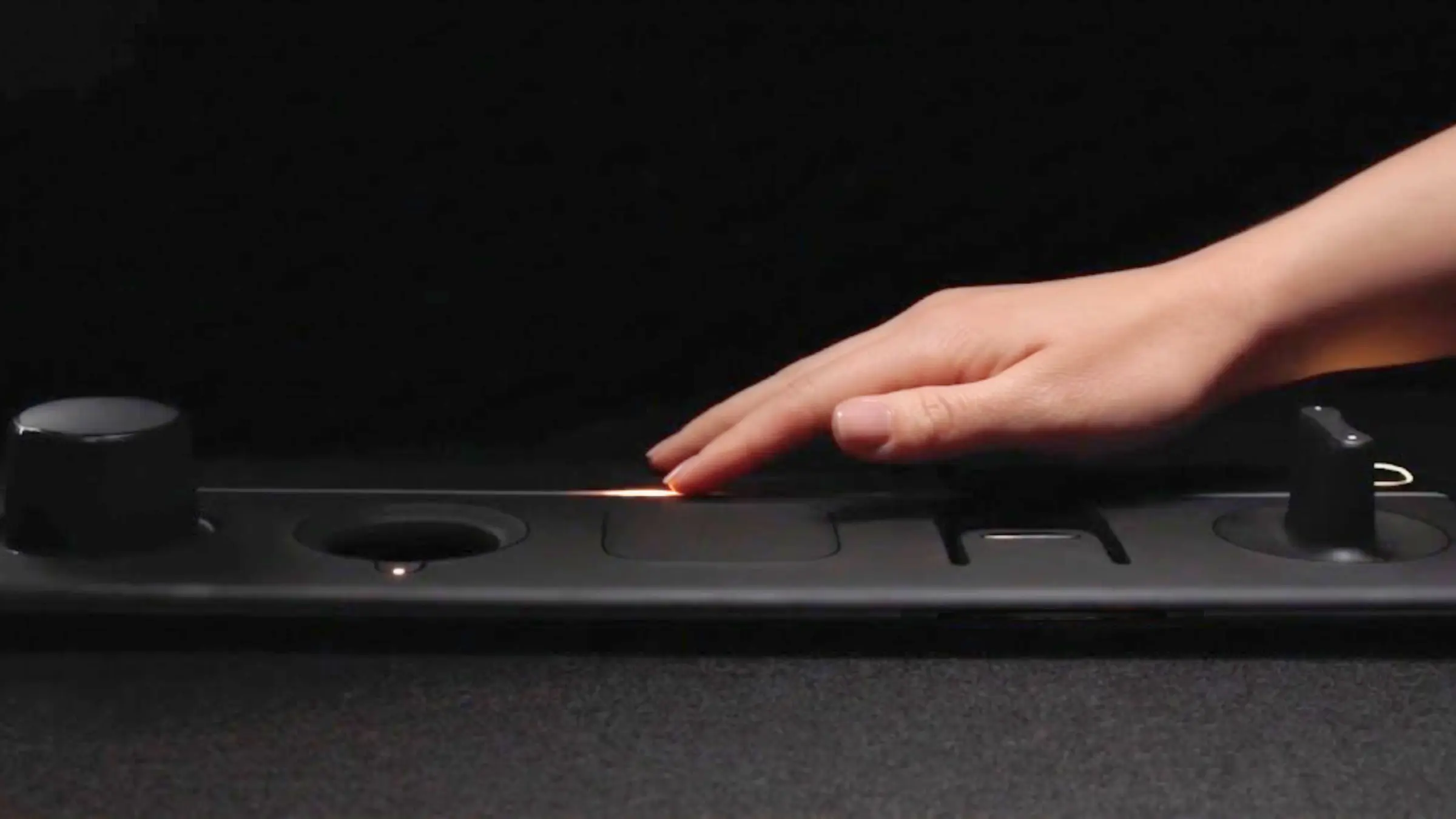
At TG0, we have a different method by engineering conductive polymers so that the material itself becomes the sensor. A single moulded layer detects touch, pressure, and shear, read by one chip and interpreted using our AI signal-processing algorithms. Instead of stacking extra parts, TG0 functions as an integrated platform. Here is a quick breakdown of how this compares to traditional components and where each technology fits best.
Which sensing approach fits which requirement?
1. Mechanical Buttons and Switches
- What it senses: On/off, sometimes travel
- Where it is strongest: Unambiguous physical feedback that users trust
- Typical constraints: Moving parts, separate seals per control, fixed positions that shape the design
- Where TG0 changes the trade-off: Sensing is moulded into the surface with no moving parts (but allowing for displacement); one window-control comparison removed 80% of components; where a physical click is needed, a haptic actuator is added.
2. Membrane Switches for Sealed Interfaces
- What it senses: On/off at fixed points
- Where it is strongest: Low cost, thin, sealed, well understood; often rated for a million or more actuations.
- Typical constraints: Layered inks and adhesives; known failure modes include delamination, moisture ingress and tail cracking [Source]; largely flat
- Where TG0 changes the trade-off: No printed or laminated sensing layers; follows 3D geometry; reads levels of pressure as well as presses.
3. Capacitive Touch Electrodes and Controllers
- What it senses: Presence and position of a finger
- Where it is strongest: Mature, low-cost controllers; ideal for flat panels and screens
- Typical constraints: Water and gloves can cause false or missed touches without extra countermeasures; electrode stack limits surface material and shape; detects contact rather than force
- Where TG0 changes the trade-off: Capacitive sensing runs through the bulk material, so the same surface can also measure pressure and deformation; works under a customer's chosen surface material.
4. Force-Sensing Resistors (FSRs) for Pressure Sensing
- What it senses: Change in force at a point
- Where it is strongest: Cheap, thin, quick to prototype
- Typical constraints: Manufacturers state they are not intended for accurate measurement; typical datasheets list around 5% hysteresis and ±4% part-to-part variation; discrete points leave gaps.
- Where TG0 changes the trade-off: A continuous material maps where force lands across the whole area; stiffness and sensitivity can be tuned to the application.
5. Load Cells and Precision Force/Torque Sensors
- What it senses: Precise force on one or more axes
- Where it is strongest: Calibrated, high-accuracy measurement; the standard for metrology.
- Typical constraints: Rigid, comparatively bulky, and report total force rather than where on a surface it is applied.
- Where TG0 changes the trade-off: Distributed force data across a surface; TG0 is not positioned as a replacement for calibrated metrology; its data is better suited to indicative pressure.
6. Pressure-Mapping Grids and Mats
- What it senses: Distributed pressure
- Where it is strongest: Established in clinical and research measurement
- Typical constraints: Row-and-column matrices with many connections, usually laid on top of a product as a measurement tool.
- Where TG0 changes the trade-off: Built into the product itself as one material and one chip.
7. In-Mould Electronics (IME)
- What it senses: Capacitive touch, plus lighting, antennas and other circuitry
- Where it is strongest: Integrates printed circuits and components into a single moulded part with a decorative finish.
- Typical constraints: Built on printed conductive inks and thermoformed film; touch is primarily contact-based.
- Where TG0 changes the trade-off: The moulded material is the sensor, adding pressure and shear sensing; in-mould electronics remains stronger where lighting and other electronics must be integrated.
8. Camera-Based Tactile Sensors for Robotic Grippers
- What it senses: Contact shape, force, slip
- Where it is strongest: Very high spatial resolution; widely used in research
- Typical constraints: Most run at 30 to 90 frames per second, which limits fast slip response; thickness is tied to camera optics; image processing is computationally heavy.
- Where TG0 changes the trade-off: Ultra-thin shear sensing at higher sampling rates.
When conventional technology is the better choice
TG0 shines when your product needs multiple sensing modes, complex 3D curves, seamless sealing, or a reduced component count. However, as engineers, we know that conventional technologies remain the better choice in several scenarios:
- Calibrated, metrology-grade force measurement on a single axis, where load cells remain the standard.
- A simple on/off control at a fixed point in a cost-driven product, where a membrane switch or mechanical button is cheaper and proven.
- Flat touchscreens, which capacitive touch controllers handle extremely well.
- Off-the-shelf procurement with no development work. Most TG0 projects involve a design and engineering phase, and the shear-force evaluation kit is the closest TG0 currently comes to off-the-shelf.
The TG0 Benefits*
- 25% Cost Saving: Achieved in a TG0-enabled trackpad assembly when compared against a consumer-grade electronics bill of materials.
- 33% Carbon Reduction: Validated through a lifecycle assessment of a TG0-enabled automotive seat switch against a standard sensor assembly.
- 45% Weight Reduction: Delivered by a TG0-enabled seat-switch assembly compared to a traditional wired assembly with support components.
- 80% Component Removal: Demonstrated in a TG0-enabled car window-control assembly against a standard electronics-based equivalent.
*Each figure comes from one product comparison. Results for a new application depend on its design, materials and volumes.
Have a product where one of these trade-offs is holding you back? Get in touch today.